
BioTechniques News
Tristan Free
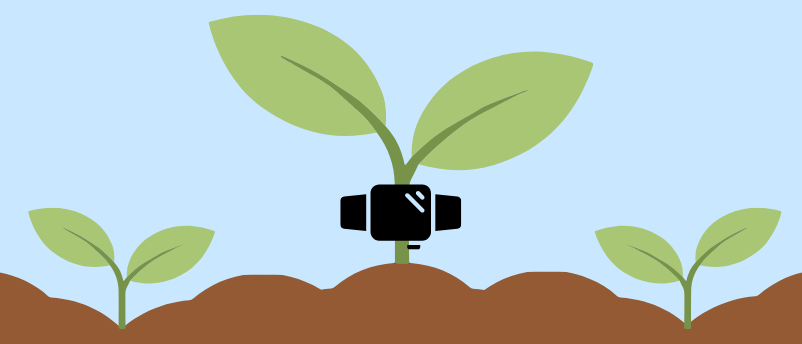
Forget your smartwatch or fitness tracker; this latest development in wearable technology turns its attention to the plant world. Tiny, tattoo-like sensors and a kirigami-inspired band that wraps around stems have been designed to track the health of our leafy counterparts, because why should humans have all the fun?
Acting like wearables for plants, novel sensors from Tufts University (MA, USA) could advance crop monitoring, providing farmers with real-time feedback on plant hydration and growth dynamics. This could help them to keep an eye on plants’ responses to environmental stressors, and in future, maybe other indicators of plant health, including nutrient and hormone levels or response to pathogens, ultimately improving crop management.
With climate change taking its toll on global agriculture, many farmers are exploring a data-driven approach in precision farming, central to which is the efficient monitoring of crops. Recent advances in this area have focused on remote sensing, satellite imaging and drone-based technologies, which can measure indicators of crop stress like uneven growth, temperature, pest damage and soil moisture.
While valuable, these approaches fail to demonstrate how a plant is responding in the moment, before visible signs of stress have appeared. Leaf sensors, on the other hand, can recognize early warning signs, although current options often struggle to track multiple stressors and growth parameters and usually rely on external batteries.
 Soil searching: new dPCR ‘DNA test’ roots out plants’ subterranean secrets
“It’s a bit like giving the soil a DNA test.” A new ddPCR method quantifies root DNA directly from soil samples, providing an invaluable insight into plant biomass and carbon storage.
Looking to change that, the Tufts researchers have introduced a scalable plant health monitoring system, consisting of a tattoo sensor that attaches to the leaf surface and estimates relative humidity and temperature, and a wrap-around sensor for monitoring radial stem growth inspired by kirigami, the Japanese art of paper cutting.
The platform isn’t powered by a battery; instead, the tattoo sensor harvests power from ambient moisture using a nanosheet membrane containing vanadium pentoxide crystals. The nanosheet is situated between graphene-coated layers to create a moisture electric generator that delivers just over 0.1 microwatts of power per square centimeter. It exhibited high sensitivity to humidity and temperature, enabling accurate vapor pressure deficit estimation for over 10 days until leaf senescence.
Meanwhile, the stem-based sensor is coated in eutectogel, which changes electrical resistance as the stem expands and contracts, allowing continuous tracking of stem diameter for more than 20 days.
Putting their system to the test in bell peppers, the researchers demonstrated that it was able to distinguish and detect two major forms of stress: water deficit and high salinity. It also holds promise for powering macronutrient, phytohormone and biopotential sensors.
Overall, the study underscores the sensing platform’s potential for large-scale agricultural use to monitor abiotic stress and improve crop management.
“The larger promise is not merely that one plant can wear one sensor,” commented senior researcher Sameer Sonkusale. “It is that fields could one day contain networks of plant-level monitors, each reporting early signs of thirst, salt stress, disease or nutrient imbalance. Satellites and drones already give farmers a bird’s-eye view. Plant wearables could provide something more intimate: the plant’s-eye view.”
The post A smartwatch for plants? Scientists create ‘wearable’ sensors for tracking plant health appeared first on BioTechniques.
Powered by WPeMatico