
BioTechniques News
Tristan Free
‘Living textiles’ made from a parasitic fungus could be the next big thing in sustainable fashion. Sure, it’s a little avant-garde, but it might, quite literally, grow on you.
A caterpillar fungus might sound like the farthest thing from haute couture imaginable, but not according to a recent study from researchers at the Chinese Academy of Sciences (Beijing, China), who have created what they call ‘living textiles’ using the fungus Cordyceps militaris. They hope to one day use their experimental new material to create eco-friendly clothes, which can biodegrade and even repair themselves if damaged.
In the pursuit of next-generation sustainable materials with the capacity for adaptation and regeneration, engineered living materials have come to the fore. These biomaterials harness metabolically active cells to confer the ability to self-repair, respond to environmental stressors and perform programmable biochemical functions. A common challenge, however, is the seamless unification of structural integrity with sustained biological activity at macroscopic scales.
This recent foray into fungal fashion has leapt past that hurdle, establishing a methodology that preserves the viability of C. militaris mycelia within macroscale films. To start, the researchers grew the fungi in liquid culture to form spherical mycelial pellets, which then underwent low-energy fusion to form free-standing sheets. Treatment with glycerol increased flexibility, allowing the material to be folded, twisted and shaped into complex geometries, such as origami cranes, without cracking. Then, the team worked four strips into a rope, which successfully supported a 1 kg weight.
What’s more, when they made a series of cuts in the fabric, these visibly rejoined upon application of a few microliters of water followed by ambient drying. Mechanical testing revealed that restored samples retained impressive load-bearing capacity even after multiple repair cycles.
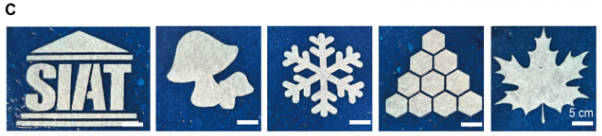
The fungi-fortified textiles also retained the capacity for environmental response, as was demonstrated when the researchers stimulated aerial hypha – the reproductive precursor structures that emerge from subterranean fungi to reach the surface – formation by depositing a nutrient solution in predefined patterns. The embedded mycelium remained viable, which triggered C. militaris hyphae to germinate and extend outward in various shapes, including a snowflake, a maple leaf and the substantially less whimsical logo of the Shenzhen Institute of Advanced Technology (China), as seen below.
To illustrate how their living materials can acquire additional biological functions, the researchers integrated engineered microbial partners via coculture. Saccharomyces cerevisiae produced pigment to color the surface of the material blue, red, orange and purple, while melanin-rich Aspergillus niger provided ultraviolet protection – all without compromising structural integrity.
Finally, life cycle assessment and biodegradation studies confirmed that the textiles almost completely broke down within 41 days. Together, the findings point to a programmable, environmentally responsive and inherently sustainable living material.
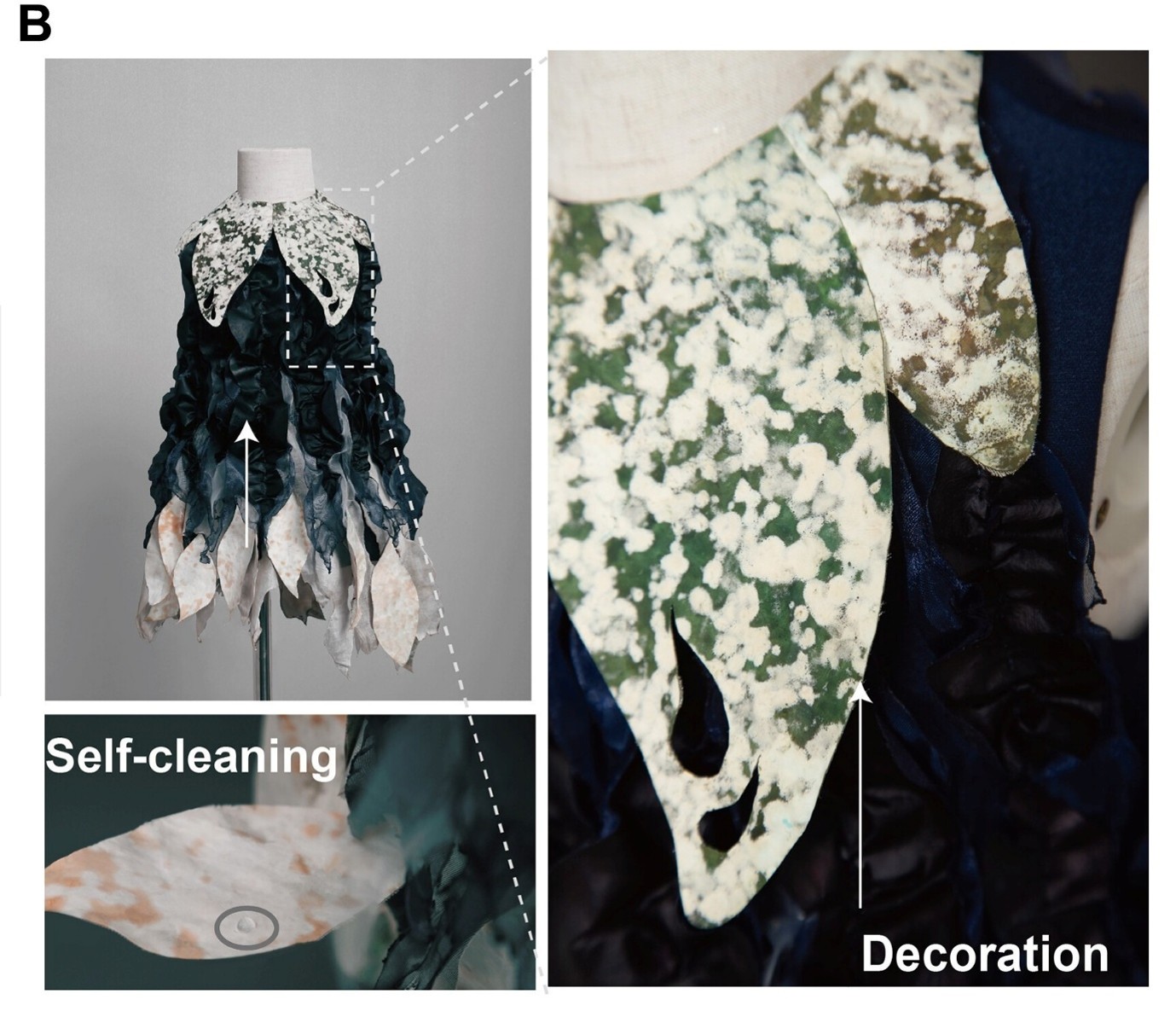
The team was also able to fabricate the material into a prototype dress, incorporating pigment-producing yeast for coloration and aerial hyphae for surface functionality, thus demonstrating its sustainable fashion credentials.
Granted, it may be a while before we see Cordyceps couture on the runway, but its potential uses stretch way farther. As the study authors write in their conclusion: “Beyond textile analogs, this paradigm provides a foundation for the broader development of adaptive, living material platforms across biomedical, environmental and architectural domains.” Pretty chic if you ask us.
The post Cordyceps couture: textiles made from live fungi shake up sustainable fashion appeared first on BioTechniques.
Powered by WPeMatico