
BioTechniques News
Beatrice Bowlby
Original story from Hubrecht Institute (Utrecht, Netherlands).
The intestines use the rhythm of a signal to decide which cells to make, improving our understanding of healthy tissue maintenance and disease disruption.
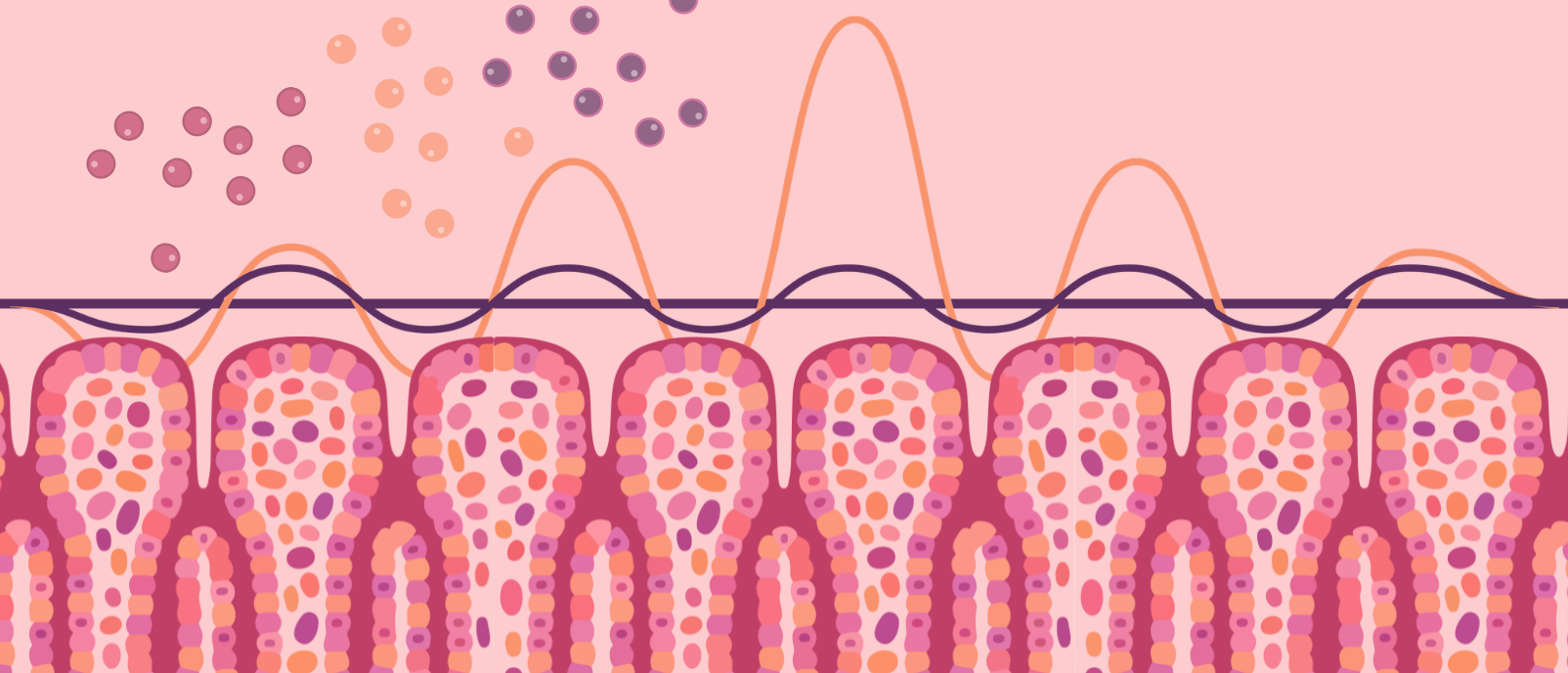
A study conducted at the Hubrecht Institute (Utrecht, Netherlands) reveals that the intestines use the rhythm of a signal to decide which cells to make. Researchers from the Sonnen group discovered that chemical signals oscillate at different rhythms in different cells of the small intestine. In a new study, they show that altering the frequency of these oscillations changes the balance of cell types that form. The findings may improve our understanding of how tissues maintain a healthy cell type balance and how disrupted signaling dynamics contribute to conditions such as inflammation and cancer.
The intestines have one of the highest cell turnover rates in the human body. They renew their lining every 5–7 days. Stem cells in the intestinal lining produce these new cells, which take on different roles, from absorbing nutrients to protecting the gut. To keep the intestines healthy, the body must carefully control how many cells of each type it produces.
Tuning in to cellular signals
To coordinate this process, cells communicate through their own language of chemical signals. When a target cell detects a signaling molecule, this sets off a chain of events inside the cell known as a cell signaling pathway. This pathway helps the cell determine how to respond. The activity of signaling molecules can rise and fall in waves, called oscillations. In this study, the team showed that a certain chemical signal in the gut shows such oscillations, and that the rhythm of these oscillations has a functional role in keeping the gut cells in balance.
“We found that cells not only respond to whether a signal is present or absent, but also to how often this oscillation repeats within a certain time,” explained group leader Ina Sonnen. “This means that this oscillation frequency carries additional information. It’s a bit like FM radio, where audio information is encoded by changes in the frequency of a radio signal.”

Plasticity in cancer: trying to hit a moving target
Plasticity is so often viewed as a positive in science: providing the ability to adapt, encoding protective mechanisms and forming new connections for learning. However, when cancer is the beneficiary of this ability, it makes developing effective therapeutics feel like trying to hit a moving target.
Different rhythms across the intestines
The study was led by three shared first authors from the Sonnen group: Sonja Weterings, Hiromune Eto and Jan-Daniël de Leede-Scheven. The signal they studied is called Hes1, which is a protein that helps control what types of cells are produced by intestinal stem cells. The researchers teamed up with the van Rheenen group (Netherlands Cancer Institute; Amsterdam, Netherlands) and used fluorescence to determine the amount of Hes1 proteins in cells in the mouse gut over time. They found that Hes1 levels oscillate.
The team then used intestinal organoids, tiny structures of cells that resemble a miniature version of an organ, to analyze this in detail. “We first noticed that the oscillations became slower as cells moved away from the stem cell region,” commented Weterings. “That made us wonder whether these different rhythms might have a biological function.”
“We also found that different cell types showed different Hes1 rhythms: some cell types had faster oscillations than others,” added Eto. “This suggested that the frequency of the oscillations might be linked to the decision-making of stem cells. In other words, differences in the Hes1 rhythm might influence which type of cell an intestinal stem cell becomes.”
Changing oscillations shifts cell type balance
To test this idea, the researchers experimentally changed the timing of the Hes1 rhythms in intestinal organoids. The production of Hes1 is induced by a signaling pathway called Notch signaling. To temporarily switch this pathway off at precise intervals, the team used a microfluidic system. “We delivered small amounts of a ‘brake’ chemical to the organoids at precise intervals,” explained Weterings. “By timing the chemical pulses, we shifted the frequency of Hes1 oscillations to match the frequency we provided experimentally. This meant we could speed up or slow down the oscillations and see what happened to the organoids!”
Because organoids actively produce diverse cell types, just like a real gut, the team could assess how experimentally changing the frequency of Hes1 oscillations affected cell-type composition. They did this work in collaboration with the van Oudenaarden group (Hubrecht Institute). “We saw that specific frequencies clearly changed the balance of different cell types produced by the organoids,” shared de Leede-Scheven. “This showed us that the frequency of the oscillations can actually influence which cell types are produced.” This reveals a previously underappreciated way in which tissues may control their cell-type composition.
A tissue-wide phenomenon?
The findings show that the timing of a signal can carry information that helps determine what a cell will become. “Signaling pathways are conserved across different tissues but have different functions,” concluded Sonnen. “Altering the frequency of these oscillating signals is probably an important mechanism for many of them.”
The findings may improve our understanding of how the intestines and other tissues maintain a healthy balance of cell types. They could also help researchers investigate how disrupted signaling dynamics contribute to conditions such as inflammation and cancer.
This article has been republished from the following materials. Material may have been edited for length and house style. For further information, please contact the cited source. Our press release publishing policy can be accessed here.
The post Rhythm and cues: signaling oscillations inform cell differentiation in the intestine appeared first on BioTechniques.
Powered by WPeMatico